Tell us about the job
Takes about a minute. No obligation.
Gas-fired water heaters cycle every time the tank drops below its set point, and in a county where utility gas is the dominant fuel, the burner, the thermocouple, and the ignition system accumulate wear steadily across years of daily use. Utility gas heats more occupied homes in Providence County, Rhode Island than any other fuel, at 60.9% (2020-2024 ACS 5-year). A contractor diagnosing a repair here checks the igniter and the gas valve before assuming a control board has failed, because those components absorb the most load in a gas appliance that runs year-round. Sediment buildup in the tank also forces the burner to fire longer each cycle, and that added run time shortens the thermocouple's service life.
Houses here were not built around the water heaters now running in them. Venting routes, supply connections, and the electrical service feeding the unit reflect decisions made for something older, and a contractor opening a failed water heater finds that the surrounding infrastructure sets the terms of the repair as often as the unit itself does. Half the homes in Providence County, Rhode Island were built in 1956 or earlier (2020-2024 ACS 5-year). That gap between what the house was built for and what now sits in the utility closet is why a straightforward parts replacement sometimes turns into a conversation about the flue, the supply shutoff, or the circuit feeding the heater.
The Parts of a Water Heater a Contractor Checks During Repair
The tank is the piece a homeowner notices first, a large insulated cylinder that sits in a utility room, basement, or garage and holds the supply of heated water. Attached to it are the pressure relief valve, the drain valve, and the cold-water inlet and hot-water outlet connections, each of which a contractor examines when diagnosing what has failed.
Inside the tank, the heating element or burner assembly does the actual work of raising water temperature, and the thermostat controls when that work happens. The anode rod runs through the tank's interior and slows corrosion from the inside out. These internal components are common starting points when a unit stops producing hot water or behaves inconsistently.
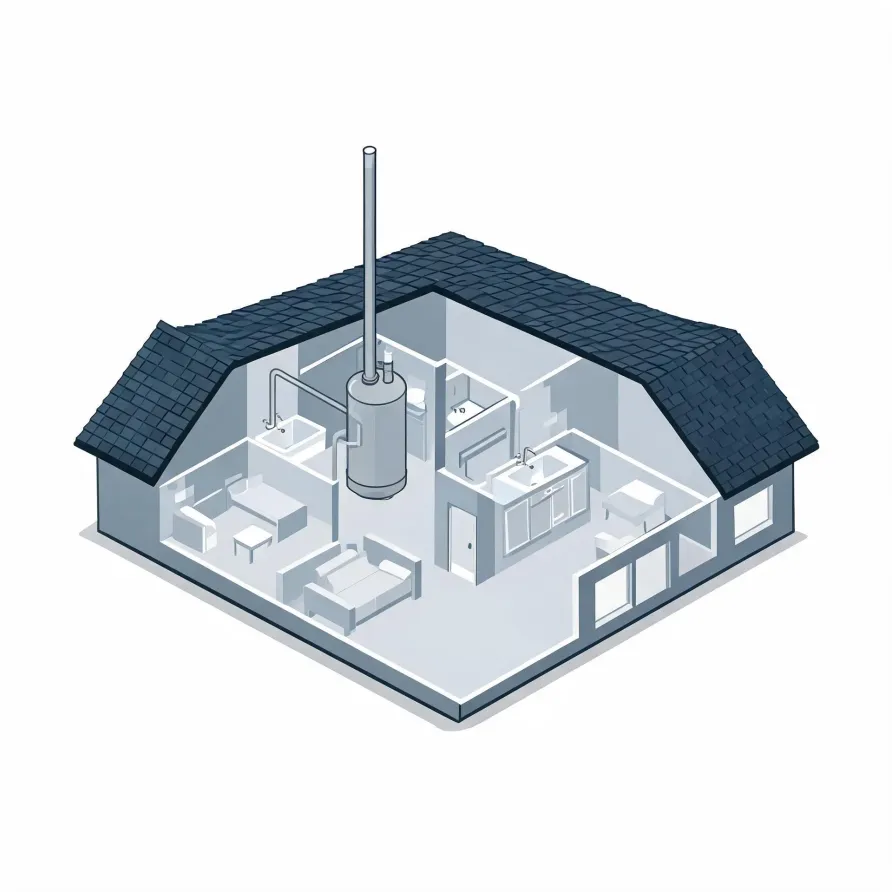
The drawing shows the general layout of a water heater system, and a licensed contractor determines which components and conditions apply to your specific unit and installation.
Get matched in Providence CountyProvidence County, by the numbers
236 severe weather events were recorded in Providence County, Rhode Island between 2015 and 2024.
NOAA National Centers for Environmental Information, Storm Events Database, bulk CSV export, events 2015-01-01 through 2024-12-31.Half the homes in Providence County, Rhode Island were built in 1956 or earlier (2020-2024 ACS 5-year).
U.S. Census Bureau, 2020-2024 American Community Survey 5-Year EstimatesProvidence County, Rhode Island holds 277,740 housing units (2020-2024 ACS 5-year).
U.S. Census Bureau, 2020-2024 American Community Survey 5-Year EstimatesOwners occupy 56.9% of the occupied homes in Providence County, Rhode Island (2020-2024 ACS 5-year).
U.S. Census Bureau, 2020-2024 American Community Survey 5-Year EstimatesCodes & Standards Covering Water Heater Repair in Providence County, Rhode Island2 sourced rules and standards
Licensing and Legal Requirements in Providence County, Rhode Island
A Rhode Island master licensee needs no separate sheet metal licence while the air handling equipment is ten (10) tons or less, or the heating equipment does not exceed 250,000 BTUs; above either figure the sheet metal work must be subcontracted to a licensed sheet metal contractor.
Rhode Island requires a licence from the Department of Labor and Training to work in the mechanical trades: nobody may hold themselves out as a master, or advertise that they will install refrigeration and air conditioning or air distribution systems, without one.
Severe Weather Events in Providence County
Extreme weather puts water heaters under pressure: temperature swings, power surges, and flooding all accelerate wear on equipment that runs year-round. How often those conditions arrive in Providence County shapes how hard local water heaters work and how quickly problems show up.
236 severe weather events, 2015–2024. Source: NOAA National Centers for Environmental Information, Storm Events Database.