Tell us about the job
Takes about a minute. No obligation.
Gas infrastructure in a home shapes every decision a contractor makes on a water heater job, from what venting is available to whether combustion air is adequate for the new unit. Utility gas heats more occupied homes in Providence County, Rhode Island than any other fuel, at 60.9% (2020-2024 ACS 5-year). That share means most replacement jobs here begin with an existing gas line, an existing flue, and code requirements written around gas appliances. A contractor quoting the work has to confirm the vent connector and termination point suit the new unit's BTU rating and draft requirements. If a homeowner wants to switch fuels, the existing infrastructure becomes an obstacle rather than a starting point, and the project scope changes substantially.
The electrical panel and the ductwork already in the house set the terms for a water heater installation before the new unit is ever ordered. Half the homes in Providence County, Rhode Island were built in 1956 or earlier (2020-2024 ACS 5-year). That vintage of housing was built around equipment whose load and routing demands were different from what a modern water heater draws and needs, so the existing infrastructure is where the job gets decided. A contractor opening the walls or the panel in Providence County is establishing whether what is already there fits the new install, or whether it has to be changed first.
What a Contractor Installs With a New Water Heater
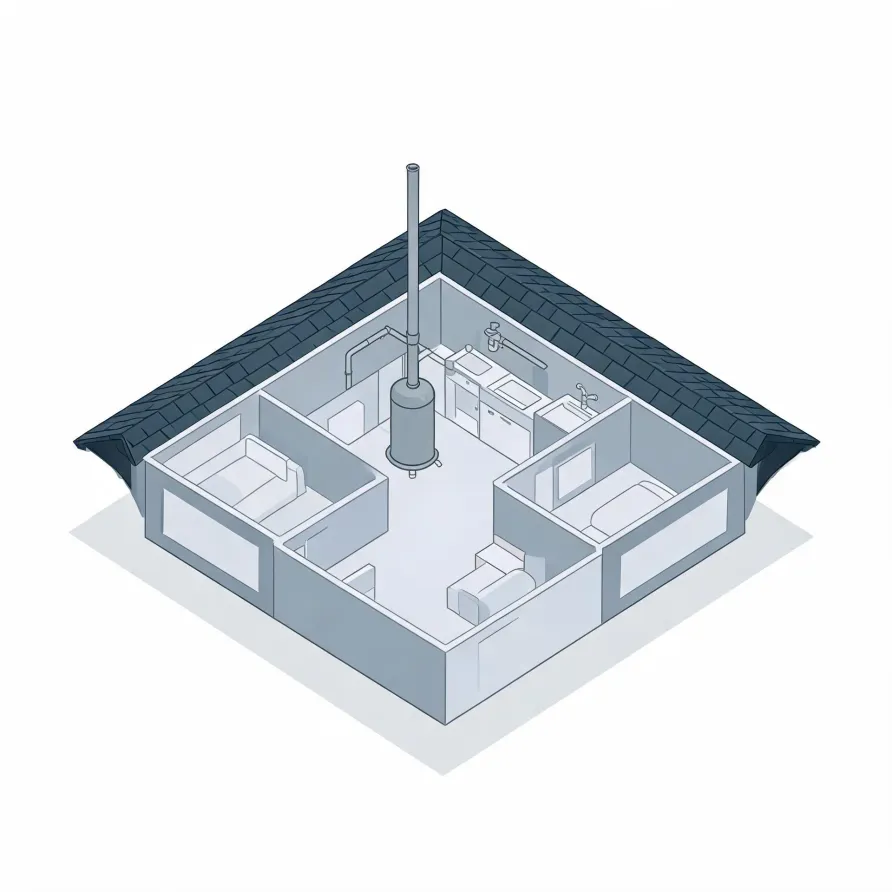
The tank or tankless unit is the heart of the system. A storage tank sits in a utility space, basement, or closet and holds a ready supply of hot water. A tankless unit mounts to a wall and heats water as it passes through, taking up far less floor space.
A pressure relief valve attaches directly to the tank and releases pressure if it climbs too high. The cold supply line feeds water in, and the hot outlet line carries heated water to every fixture in the house. An anode rod hangs inside a storage tank and slows corrosion of the tank walls.
The drawing shows a typical layout, and a licensed contractor determines exactly what applies to your home.
Get matched in Providence CountyProvidence County, by the numbers
236 severe weather events were recorded in Providence County, Rhode Island between 2015 and 2024.
NOAA National Centers for Environmental Information, Storm Events Database, bulk CSV export, events 2015-01-01 through 2024-12-31.Half the homes in Providence County, Rhode Island were built in 1956 or earlier (2020-2024 ACS 5-year).
U.S. Census Bureau, 2020-2024 American Community Survey 5-Year EstimatesProvidence County, Rhode Island holds 277,740 housing units (2020-2024 ACS 5-year).
U.S. Census Bureau, 2020-2024 American Community Survey 5-Year EstimatesOwners occupy 56.9% of the occupied homes in Providence County, Rhode Island (2020-2024 ACS 5-year).
U.S. Census Bureau, 2020-2024 American Community Survey 5-Year EstimatesCodes & Standards Governing Water Heater Installation in Providence County, Rhode Island2 sourced rules and standards
What Providence County, Rhode Island Requires for This Work
A Rhode Island master licensee needs no separate sheet metal licence while the air handling equipment is ten (10) tons or less, or the heating equipment does not exceed 250,000 BTUs; above either figure the sheet metal work must be subcontracted to a licensed sheet metal contractor.
Rhode Island requires a licence from the Department of Labor and Training to work in the mechanical trades: nobody may hold themselves out as a master, or advertise that they will install refrigeration and air conditioning or air distribution systems, without one.
Severe Weather Events in Providence County
Extreme weather puts a hard load on water heating equipment, shortening service life and pushing systems to fail at the worst times. How often that pressure shows up in Providence County shapes what a water heater here needs to handle.
236 severe weather events, 2015–2024. Source: NOAA National Centers for Environmental Information, Storm Events Database.